Winter days often roll out like the rest of the year, a mix of good and difficult times, positive and challenging experiences, moments of motivation, and moments of relaxation. However, what can make the experience of winter more difficult for our mental and emotional health is the expectation or anticipation we tend to hold around the holidays, the physical experience of cold temperatures and additional dark hours, along with the added busyness, socializing, changes to routine, etc.
So, because we know that these days can be an extra challenge to our mental and emotional health, below are some activities that can help give us a little extra care and attention as needed.
Your Mind as a Snow Globe
This one is really beautiful and a nice compliment to the season. Envision your mind as a snow globe. When shaken, everything is swirling around and it is difficult to clearly see the scene inside. Remind yourself that the swirling will settle down more quickly if you do. Still yourself and, in your mind’s eye, pick out one snowflake and watch as it slows and eventually settles on the ground. Do this as many times as it takes to feel more calm. Additionally, remember that a busy, snowy season is just that, only a season. The below video is a beautiful visual of how things will always change with time.
It can be so much harder to get outside and get the vitamin D we need for our best physical, mental, and emotional health during the winter months. There is some incredible research highlighting the importance of exposing ourselves to morning sunshine first thing when we wake up to get our circadian rhythm, hormones related to mood and sleep, etc. moving in the right pattern and direction. If you can, throw a big coat or blanket over your pajamas and get a few minutes or, even if you are not outside, drink your coffee in front of a window, looking outside. If you are interested in more of this information about morning light, check out this video from Stanford professor, Dr. Andrew Huberman.
In what has become a year-end tradition, each December I prayerfully seek out a “one word” for the year ahead. Sometimes, it comes to mind easily. Other times it’s a struggle.
This year, thankfully, it came easily and early. And, because I was fairly confident about what it was, I was amused when God seemed to affirm it with two different experiences:
A couple of weeks ago, I headed to Walmart. On the way, although I’m not sure why, I noticed I was a little keyed up. Once inside, I wandered the necessary aisles and, after being there for about 10 minutes, felt significantly calmer. In fact, the entire experience seemed extra chill. I found myself thinking, “Huh, Tuesday mornings must be the time to come here.”
Shortly after, I came across a subtle display that read, “Join us for sensory-friendly hours daily from 8am-10am. During these hours, you’ll experience a calmer shopping environment.” Bingo. It wasn’t just me and, I noticed the differences now. The lights were dimmer, there was no music, no PA announcements and, no flashing displays. My body had noticed before my brain. The difference was remarkable.
The second moment was, well, ridiculous. Pulling up to the pharmacy drive-thru, I paused the podcast I was listening to, pulled out my wallet, looked at something on my phone, and waited for the attendant. As she got on her little microphone to talk to me, I couldn’t hear anything. Uh oh, poor gal, her speaker wasn’t working.
Trying to be helpful, I pointed to my ear and mouthed “I can’t hear you.” Oddly, she pointed back. Turns out, in all my multitasking, I had never rolled down my window. We both got a good laugh out of it but, good grief, I was clearly paying attention to too many things at once.
These two experiences have cemented the idea that my one word for 2024 is…
“Focus.”
While not a new realization, I am increasingly aware of how distraction and over-stimulation work against us. One of the truths of the human brain is that we can’t-not process stimuli. While we may not consciously absorb every message, our neurons are hard-wired to fire on every word, sound, ding, flash, or vibration. It’s how our senses work. And, with all the noise that exists, many of us are getting really tired, distracted, and over-stimulated.
It’s hard on our bodies. It’s hard on our brains. And, ultimately, it’s hard on our connections with one another, ourselves, and with God.
While “focus” may not be your word for the year, I invite you to join me in making a few adjustments if it sounds appealing to you. It’s part declaration that we will change how many things we are willing to juggle at one time. It’s also part permission to believe that if we’re not constantly plugged in and available the earth will keep spinning, we won’t miss out, and people can still reach us and get their needs met. It’s part freedom to realize that we are not meant to be the whole body of Christ but instead are responsible for our part (Eph. 2:10). And, lastly, it is part invitation to hear God’s voice as He uses it to lead us, to love us…
The other day I found myself watching a bunch of children take part in a celebratory dance party. There were balloons, glow sticks, loud, crazy music, and loud, crazy children. Because that’s what kids are supposed to do sometimes. Be loud and silly. And, as you can see from this failed attempt to get a still shot of my daughter, she was having the time of her life.
So, how did I find myself at a loud, crazy dance party with tiny humans? Well, I’ll tell you.
Last summer, I did a quick search for “local children’s theater.” It quickly turned up Itsy Bitsy Broadway, a local theater program for “young performers and young audiences.” Sign-ups for the fall production of The Lion, the Witch, and the Wardrobe were open. As I had been looking for an outlet for my creative, free-spirited, theatrical daughter, I signed her up immediately. We were both pretty excited.
Our first time at the theater was the fall open house. There were snacks and drinks, plenty of costumes and instruments to play with, and memorabilia from past productions. After a few minutes, the director entered the room. It took me about 2.5 seconds to recognize I had made exactly the right choice.
This gal was all things I am not. She came in exactly as you might think a theater-loving person would. Loud, demonstrative, and speaking with great expression in a slightly British accent. She welcomed us and then led the kids off for a tour. I followed behind quietly.
Quickly, they all disappeared backstage. I could hear them going through the green room, dressing rooms, and then walking behind the set. As the director still had her microphone on, I heard her say something about going through an on-stage door to get out. Then there was some rattling, a little laughter, and the director with fantastic fake distress, “Oh no! The door is locked. Yell for help! Yell for help with drama!”
I smiled.
I’ve never encouraged my kids to do anything “with drama.” But, that’s exactly what my expressive, creative daughter needs sometimes.
Other People Are Essential to Our Children’s Development
You know, when my kids were younger, being around women like this made me question things. As an introverted, less “playful” Mama, I wondered if I was not “enough” somehow. I would see the way other Moms enjoyed their kids that seemed so different from my own experience. I mean, aren’t Moms of small kids supposed to really like kids? I liked mine, but I was far from the stereotypical “kid person.” Truth be told, I still am.
Years later, that old question of my “enoughness” still tries to pop up sometimes. But, now, it gets batted down by the truth of what I’ve experienced as I’ve embraced the gift of other people in my children’s lives. Instead of feeling inadequate, I am now grateful for the Moms who have my daughter over, sending her home loaded down with crafts. Instead of feeling like a stick in the mud, I love to watch my kids with their teachers and coaches as they play, making silly voices and faces. And, instead of thinking I have little purpose sitting quietly in the back of a children’s theater dance party, I am intentionally creating a mental reel of images, watching my daughter dance her heart out with her new friends.
To my fellow Mamas who sometimes fall prey to this same question, “Should I be everything my kid needs?” Our answer should be a firm and confident, “No.” The talents and gifts of those around us are not a threat to our value. Rather, they are simply additional lights, brightening the runway our children are traveling before someday, they take off. Frankly, I want every one of them lit so they can see best where to go.
That day in the theater, when my daughter finally tired from all the dancing, she knew exactly where to find me. In the back, sitting quietly, ready to welcome her when she was ready. She climbed in my lap, sighed, and said, “Mom, this was so much fun.”
I am so grateful, sweetheart. Please go, spread your big creative wings, I’ll be right here watching.
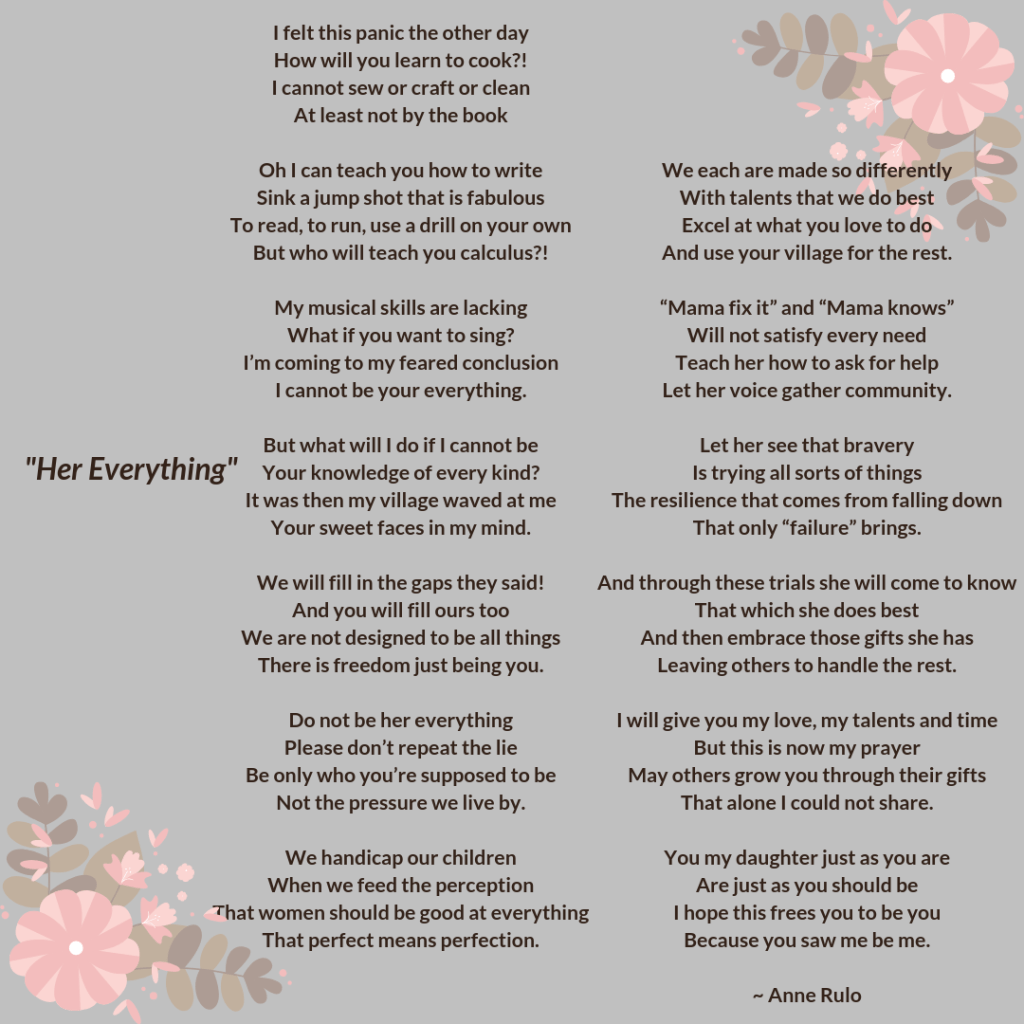
PS – In this same vein, here is a poem I wrote years ago. Thanks to all those in the village helping raise my kiddos. I am grateful for you.
I’m envisioning the regular readers of this blog seeing this title and thinking, “Huh?” Doesn’t this lady normally talk about faith? Yep. And, mental health. And, you know what kids in faith-filled households do sometimes? They experiment with drugs and alcohol (and sex, but we’ll wrangle that another time 😉).
The other day a friend mentioned wanting to talk with her kids about alcohol but had no experience herself. While of course, plenty of people of faith have experience with alcohol, many others don’t. Regardless, we all need the skills and knowledge to talk with our kids. So, I tapped into all those years as a college counselor where I had a LOT of conversations about this very thing.
Part of the secret to talking with young people about substance use (and other sensitive issues) is to have facts on hand rather than just “shoulds” and “shouldn’ts.” While you may have a moral or Biblical standard you desire, kids are often better equipped to make wise, healthy decisions when we also “layer” in information about how their bodies work and/or how substance use can impact them. This is especially true during the adolescent years when increasing independence from parents is a core developmental task.
Consider the three areas below:
Moral: Good/bad, do/don’t. This is the standard you choose for your home. Regarding alcohol specifically, you may encourage none, in moderation, only when you’re 21, etc. Regardless of what you teach your kids, it’s often not as effective if this is your only talking point. They will be better equipped if they also have other “layers” of information.
Legal: Some kids are going to be motivated to live by the standards of their parents, faith, etc. And, some aren’t. Or, they experiment for a bit during “risk-taking” years. Offering facts and having non-fear-based conversations can help them make wise choices when they aren’t in your care. Ex. “Hey, just a heads up, did you know if you drive your underage buddies around and they are drinking, even if you’re not, you can be charged with an open container violation and/or a MIP?”
Medical/Biological: This information can be gold, especially because not even many adults fully understand this piece. Knowing how substances impact the human body can help kids make independent, healthy, harm-reduction-based choices. And, they can be an informed leader for their peers. Below is some essential medical/biological information you can share with your kids.
With any substance, every “body“ has a certain tipping point for addiction. For harder drugs, it tends to be faster and sooner. Things like meth and heroin can create addiction after minimal use. For other substances, it tends to happen over longer-term use. Additionally, genetics is a factor here. If you have other alcoholics/addiction in your family, it is likely to happen for you and yours sooner.
For alcohol specifically, everyone’s liver operates the same way. With rare exception, humans can only digest/break down one “standard drink” per hour. But, what many kids don’t realize is that a standard drink is a different size for different types of alcohol. In general, a 1.5oz shot is a standard drink, 4-5 ounces of wine is a standard drink, a beer is a standard drink. It all has to do with the alcohol content. So, if you kick back four shots you will still have alcohol in your system until four hours later.
Additionally, binge drinking (which is highest among young adults and increases the risk of addiction) is considered four to five standard drinks within two hours. The more people drink the more they will feel differently based on their tolerance, body weight, if they’ve eaten, etc. This is the point a lot of kids (and adults) don’t understand. Just because they might feel “OK” doesn’t mean the alcohol is completely out of their system. This is the kind of thing that gets people pulled over and they blow over the legal limit even though they don’t feel intoxicated. It is safer (and easier) just to do the math rather than hope or “feel like” your BAC (blood alcohol content) is below the legal limit.
Of course, there is no way to keep our kids completely safe, but if they understand how alcohol processes in the body, the benefits of limiting it, knowing “tricks” like making sure to drink water in between alcoholic drinks, etc. can help them make safer choices if they drink. Or, if they don’t, be able to say to their buddy, “Hey, you had five beers two hours ago. The math says you aren’t clear to drive.”
Finally, on a positive note, the rate of risky and binge-drinking behavior is actually declining among several generations, including our current young people. To read more about how it is becoming more acceptable than ever to avoid risky drinking, link here.
Addiction and substance misuse is a tough journey in many families. Like anything else that’s difficult to talk about, having conversations about alcohol use doesn’t make kids drink. But, not talking about it may leave them ill-equipped to know how to handle the pressures they will face at some point. Just like sexuality, social media use, and other “growing up” issues, substance use is something that is an ongoing, developmentally appropriate area to continue discussing.
Blessings on your conversations with your precious kiddos.
In every generation are giants in the faith who fall after years of service in the ministry. Whether local pastors or major television personalities, their stories are splashed across the media, and their circumstances, secrets, and salvation are debated.
Our reactions tend to vary. Some of us quietly turn our heads, hoping to be polite by not drawing further attention. Others of us are intrigued by the circumstances and eager to know the details. Still others are sad, angry, or feel betrayed. Regardless of how we react, one thought is particularly dangerous—looking down at our fallen brother or sister and thinking, That would never happen to me.
Let me be clear: we are never in more trouble than when our judgment takes the form of perceived immunity.
Someone recently put the book of 1 Kings in front of me. For those of you who are as ignorant about this section of Scripture as I was, it covers the change in rule from David to Solomon as well as a heaping bunch of details about Solomon’s reign as king.
Solomon has always sat in one of those “favorite biblical character” spots in my mind because he penned the wisdom found in Proverbs, Ecclesiastes, and Song of Solomon. As the beloved son of David and Bathsheba, he seemed to be the nicely bow-tied answer to the mess David got himself into the generation before. God chose Solomon to build the temple at Jerusalem. Solomon received two in-person meetings with God. And he was blessed with the distinction of being the wisest man who has ever lived and will ever live. In addition to giving him this exceptional gift of wisdom, God also saw fit to bless Solomon with wealth and honor that had “no equal among kings” (1 Kings 3:13 NIV). Both inside and out, he was fully equipped to be the best king Israel had ever known. And for a good long while, he was.
On the whole, for the first ten chapters of 1 Kings, Solomon is kicking butt and taking names for God. The written material he has produced and the work he has accomplished are absolutely staggering. He’s ruling his people with great discernment, and the kingdom is thriving. However, just after we’re told how he completes the temple at Jerusalem, knocking out the biggest blessed project God entrusted to him, the text starts to reveal previously unnoticed chinks in Solomon’s armor. For one, Solomon had an issue with the ladies.
Despite having his every physical and spiritual need met in abundance, Solomon decided he also needed women. Lots of women. Scripture tells us he had seven hundred wives and three hundred concubines. They were foreign women from foreign lands who worshiped foreign gods. They were “from the nations about which the Lord had told the Israelites, ‘You must not intermarry with them, because they will surely turn your hearts after their gods’” (1 Kings 11:2 NIV).
And that’s exactly what happened. Just as God said. Solomon the great and blessed king turned away from God.
What a strange ending to a great beginning.
What sobers me most about Solomon is that over and above all the splendor in his life, God had blessed him with more discernment and wisdom than any of us will ever have—and yet he fell. Hard. His desire for those women and their gods blinded his wisdom and replaced his love for God. The back end of his life became a shattered mess that only vaguely resembled its former self.
Suffice it to say, Solomon did not end well. And if he wasn’t above it, then neither are we.
Suicide Prevention Month comes with a lot of public health information on suicide prevention as well as statistics and education about new resources aimed at reducing the incidence of suicide. However, despite best efforts, sometimes we still lose people. As the twelfth leading cause of death in the general population, the second for people aged 10-14 and 25-34, the third for 15-24-year-olds, and fourth for those 35-441, as well as a significant risk for middle-aged men and the elderly, it is likely that you or someone you know will be impacted by a loss by suicide.
Those who lose someone they care about to suicide are often referred to as suicide “survivors.” While losing someone you care about for any reason is challenging, a loss by suicide can carry with it unique, complicated grief. If you or someone you know loses someone to suicide, this information may help you cope.
Suicide Often Results in Complicated Grief
One of the most difficult parts of a loss by suicide is the shock that accompanies the loss. For those who have seen Alice in Wonderland, the scene where Alice falls down the rabbit hole and everything is upside down, confusing, and disorienting, is a good mental picture of the way the world seems to lose its mental “footing” during this type of loss and shock.
Because our brains do not like to feel so disoriented and ungrounded, people tend to respond in one of a couple of ways to initially cope with a loss by suicide. The first, as mentioned, is shock which may play out as feeling numb or detached. When someone experiences trauma (which loss by suicide can be) numbness can protect the mind from overwhelm. On the flip side, some survivors experience intense emotions like anger or sadness that may feel like they come in “waves” as they attempt to process the loss.
Similarly, some people experience denial, feeling as though they aren’t affected while their brain takes time to process the information. It is not uncommon for some people to have a delayed reaction to loss by suicide until they have time to analyze the loss and emotions.
Because our brains want to make sense of things that are disorienting, many survivors struggle with guilt or a strong desire to understand “why” the loss happened. These thoughts can feel almost obsessive, taking up a large portion of a survivor’s thinking as they attempt to understand how this loss could have been prevented and/or want to understand everything they can about what the person they lost was feeling, thinking, etc.
Risks and Challenges Associated with Loss by Suicide
A loss by suicide has unique risks and challenges. One of the most difficult is that the concept or act of suicide has a complicated historic relationship with morality, religion, personal or family image, etc. While we know that suicide is a mental health crisis that deserves compassion and understanding but, for some, the stigma remains. It is important that those who lose someone to suicide find support from people who are compassionate toward this type of loss, rather than critical or shaming.
While thoughts of death are not uncommon after losing someone close to you by any means, the intensity of losing someone by suicide can increase this possibility. It is important to know that feeling as though the pain is too much to handle or having thoughts about your own death are not unusual. As with any loss, grief never “disappears” but the intensity will decrease over time. Until it does, get the support you need from friends, family, and/or professionals. If thoughts of your own death feel too intense to handle, seek help in a local medical center or call the National Suicide Prevention Lifeline at 988.
Support & Recovery
“Recovering” from a loss by suicide doesn’t mean getting “over” it. It simply means finding a way to move forward and gain your mental “footing” again. As mentioned, it is essential to find a support network of friends, family, and/or professionals who are compassionate and understanding of this particular kind of loss to help you through…
Today we are going back a couple of decades to the image of a telephone. Specifically, the ivory/yellow one that hung in my childhood kitchen. The base held a receiver with a curly, dangling cord, slightly stretched. And there, in the upper right-hand corner, a plastic-covered, numbered piece of paper with names carefully spelled in my Dad’s handwriting.
Of the ten or so names on this list, most were relatives. The grandparents came first, closely followed by some aunts and uncles, and there, toward the bottom, were some friends who had made the coveted “speed dial” slots. I remember my 10-year-old self thinking pushing one button to call someone was pretty darn neat.
Fast-forward, of course, the landline has largely gone the way of the dodo. But, the speed dial? That concept is still going strong. I still have a “favorites” list on my phone along with established group texts, the modern-day version of whom we choose to communicate with early and often. These are the people we reach out to when good things happen, when the proverbial poo hits the fan, or those we know will appreciate a well-timed meme or GIF to represent a situation.
So, after all these decades of improvements in communication, does the ease and habit of being able to immediately reach a human ever work against us? My thought is yes, particularly in one specific way.
It’s always wise to look closely at something that has become habitual.
For example, when I am sad, happy, or amused I immediately communicate with my Mom, sisters, or Aunt. When my kids do something funny or frustrating, my friends are often first on the list. Spiritual conundrum? Call my Pastor. Something to celebrate or a need for the kids, the house, or the schedule? Contact the husband. And, of course, if I have a question about any other random thing I inquire of my other good friend, Google.
Do you know who I almost never hit up first anymore?
Jesus.
While this truth has been hard to swallow, I realize I have developed a habit of going the easy and predictable route of communication. The people on the other end of that call or text are tangible and often, readily available. They also provide the instantaneous feedback we have become accustomed to.
Hear me clearly, our support systems and savviness for gathering information are not problems per se. We need people. And, we absolutely should use the resources at our disposal to gather sound advice and information. However, the problem develops when our communication patterns get out of balance.
When we always reach for the phone instead of pausing with Him, we are bypassing the One who has all the perspective we could ever need. When we immediately send a text, we miss an important opportunity to train our spirit to hear His voice. When we don’t take a second to celebrate with Him, cry out to Him, or inquire of His wisdom we are potentially missing out on a sweet moment where He may just show up with something incredible.
We want to be a people whose habit is to pause and inquire of God before we go to anybody else. This may only be for a moment or, we may be led to sit with Him longer. Either way, this will let Him lead first and that is always a good start.
God help us all learn to hit our knees before the send button, putting You first on our speed dials. Exactly where You belong.
“Call to me and I will answer you and tell you great and unsearchable things you do not know.” ~ Jeremiah 33:3 (NIV)
(Originally published April 1, 2019. Has been updated for freshness & clarity.)
As a non-church kid, the terms “sabbath” or “sabbatical” were completely foreign to me growing up. It was only later, during my years working at a college, that I first learned about professors taking “sabbatical leave” for rest, travel, and/or research.
Additionally, I now know pastors or parachurch workers who have taken sabbatical leave (often a few months) as part of their vocation. As a person trained in mental/emotional health and burnout prevention, this always seemed like such a good idea that clearly yielded benefits for these folks. In fact, I kind of wondered why everyone wasn’t doing it.
So, Where Does the Sabbatical Concept Come From?
As you might imagine, both “sabbath” and “sabbatical” are derived from similar places: the Greek “sabbaton” and even further back, the Hebrew “shabbath” meaning rest. The most common application is the day of rest God established in Genesis and later reminded His people to observe many times, in both the New and Old Testaments. Additionally, there is an interesting, longer Sabbath practice mentioned in Leviticus that refers to rest from work every seventh year, the time frame still guiding many universities and religious organizations today.
So, while I am not a professor nor a pastor, I am a limited human who recently thought, “I wonder if a longer sabbatical period in my own life might be helpful?” Turns out (unsurprisingly) yes. And, I’d love to share with you what I learned.
What I Learned in My First Sabbatical
Be Intentional About Timing: God designed us to rest. And, He designed us to work. Although it may sound counterintuitive, I intentionally took this sabbath from some of my own work during one of the busiest seasons in our family life. As is reflected in many stories of Jesus healing people on the Sabbath, rest doesn’t always mean shutting down work completely (although it can and sometimes should). Instead, it may simply be a time to narrow one’s focus on the most important work for a specific time so we can work and get rest rather than completely wearing ourselves down.
It Was (Mostly) Freeing: Because my own work had been set aside, it was freeing to simply write down things I needed to do after the sabbatical was over, collect ideas for writing, etc. Admittedly, it was initially uncomfortable to not attend to tasks just because they were there. But, ultimately it developed some needed discipline and understanding that more things can wait than I sometimes realize.
It Exposed True Priorities: In busy times with less margin, I say things like, “When I have a moment I’ll take care of (fill in the blank).” As it turns out, I actually did care about cleaning the basement but, no amount of extra time brought about tending the flower beds. It is freeing when we take time to figure out what actually bothers us and what things we can remove from our mental load.
It Increased Trust Exponentially: My break lasted about a month. In that time I had to trust that God was taking care of what I was not tending to. In fact, that is the whole point of Sabbath from the very beginning. Whether it is our required weekly day of rest or a longer period, it is all aimed at one point. Will we rest so He may increase our trust in His provision and decrease the worship of our own self-sufficiency?
Are You Considering a Longer Sabbatical?
The “right” requirements around the Sabbath can get deep in the weeds quickly. What day, how long, what is and isn’t allowed, etc. have been debated for eons. However, what I know is this. Very few of us “rest well” or, perhaps better said, rest with intention. Whether from our own compulsion or habits, or our urgent, technology-driven culture, we live in a time when it is uniquely difficult to pause.
Rather than collapsing at the end of a day, week, or season because our bodies simply can’t go anymore, I wonder if we all may benefit from inquiring of the Lord what a more purposeful rest might look like within our individual circumstances.
I keep it pretty simple as a parent. I do my best to love and affirm my kids while keeping them fed and clothed. I make sure they get outside. We read books. Nothing special, but hopefully consistent enough to combat my less-than-stellar parenting moments. But, every once in a while, a unique little gem pops into our routine that turns out to be super helpful. That happened the other day, so I figured I would share.
Long before I had children, I loved learning about emotional intelligence. The majority of my professional work has been with adolescent young men and women, many of whom didn’t know how to identify and/or work through their feelings. Fast-forward to parenting and that commitment is reinforced. Little people need the safety to feel, identify and learn to cope with their big feelings to eventually become functional adult versions of themselves. And so, we spend a lot of time naming and validating their feelings, helping them along this road of emotional intelligence.
However, as my children have gotten older, I have started noticing that just naming and validating their emotions seemed to leave them floundering a bit. It seemed to be caused by not knowing how to ask about what upsets them. And that’s where the “knowledge question” was born.
What is the “knowledge question”? It’s basically an add-on response to emotional validation that helps when kids are worried and need information. It goes something like this:
“It sounds like you have a question.” (A reflection of their need for information) or, “Would you like to ask a question?” “Is there something you’d like to ask me?”
It may sound simple but it’s been a game-changer. Let me give you a couple examples.
My oldest worries about natural disasters. We have researched the area to make sure our home is safe from floods and note we’ve never been directly hit by a tornado. Then, the other night he walked into the living room and asked, “Can you show me a map of the world?” When I asked why, he broke into tears, “I don’t want to die from a tsunami!”
As I sat on my couch (in Missouri) I internally rolled my eyes. But then, I remembered the knowledge question. “I see that scares you, buddy. Would you like to ask a question?” And the coolest thing happened. The gears started turning, the tears dried up, and the scared little boy stood and asked, “Can tsunamis get to our house?” “Nope. Tsunamis only happen near oceans. We don’t live near the ocean.” “Okay Mom, thanks.” And off to bed.
Part of the reason the knowledge question works is that it’s empowering. In addition to validating our children’s feelings, we give them the opportunity to be information gatherers. The ability to seek out resources and knowledge is a foundational skill-set for their success in the world. And, when we offer the knowledge question, we give them a safe place to practice that with us.
Here’s another example.
My youngest is into “fairness”. At breakfast, I handed her brother two gummy vitamins. As I turned to get hers she burst into tears, “But I wanted gummy bears too!” I wanted to say something harsh (“Chill out, I’m getting them”) but instead, offered the knowledge reflection, “It sounds like you have a question.” Big blue eyes and crocodile tears looked at me and said, “Mom, can I have vitamins too?” I was then able to remind her to ask questions, be patient and then we moved on without me shaming my child and with her problem-solving skills enhanced. She was given the chance to advocate for herself, rather than having me fix the problem for her.
So, if you think the knowledge question might be helpful for your kiddos, here’s a few thoughts:
It can take them a while to figure out how to ask a knowledge-seeking question. My four-year-old was initially frustrated, “I don’t know what the question is!” No worries. This offers you an opportunity to work through how to form an information-seeking question as well as explore what might be bothering them. In the tsunami example, I might say, “What is it you are worried about?” His answer is going to point me toward whether he is worried about dying by a tsunami in Missouri or worried about the uncle who lives near the ocean we are planning to visit. Kids think some wild stuff and we can’t always assume why they are worried about something. This way, you get more information, and then you can help them form what would have been an appropriate question afterward as practice.
If they are “too far gone” emotionally, they will not be able to form a question. The prefrontal cortex of our brain is the first to shut down in a panic and we need that part to have any sort of rational thought. If they can’t come up with anything because they are too upset, focus on deescalating and try again later.
They are not always going to like the answers we give them. However, no matter if they like it or not, remember to praise their problem-solving, resource/information-seeking efforts. If we actually lived near the ocean and needed to plan for a tsunami we would have just continued on our research journey. “Yes buddy, we could have a tsunami here but I am so proud of you for wanting to think through the options. What questions do you have about how we plan to be safe?” Or, if I had told my daughter “no” because she threw a huge fit about the vitamins I can still say, “I am so glad you asked me about having vitamins. What questions do you have to make sure you are able to get a gummy next time?”
Well, there you have it. Thanks for hanging with me. This change in my parenting language has been so helpful with my worrisome, tear-prone kiddos that I really wanted to pass it along. I truly hope it may be helpful for you in growing investigative, independent, resource-obtaining little humans. The same ones who will come to us someday and say, “I had a problem and I figured out what I needed to know, all on my own!”
(Originally published 2/28/23, updated for clarity and freshness.)
We had been out of school for hours when a little voice piped up from the back seat.
6y/o: “Hey Mom, you know what a boy said to me today at recess?” Me: (bristling because I can hear she’s upset) “What’s that, honey?” 6y/o: “He said,” (voice growing louder and shakier) “Boys go to college to get more knowledge, and girls go to Jupiter to get more STUPIDER!”
I tell you what, it was a good thing I was sitting in front of her because, at that exact moment, I found myself caught between several competing responses.
On the one hand, I wanted to laugh because 1) I was a little relieved and 2) that ridiculous saying has been around for-ev-er and it sounded impossibly cute coming out of her mouth. On the other hand, I could definitely feel my internal feminist uprising, ready to steal the entire moment.
Instead, I settled on this: “Huh. What did you do?” 6y/o: “I frowned at him and walked away.” Me: “What do you think he thought?” 6y/o: (confidently) “I think he knew that wasn’t okay.”
Phew. She handled it. And, more importantly, she felt good about how she handled it. And, I would never have known that if I hadn’t offered her a neutral response. I’m so grateful for this option to offer as a gift to our kids in conversation.
How & Why to Offer a Neutral Response
Neutral responses sound like they should be easy, but they often aren’t. We live in a culture where opinions dominate and neutrality and listening are sometimes labeled as weakness. And, when it comes to our kids, of course we don’t feel neutral. We have opinions on most of what they share with us. But, we have to figure out when it is helpful to share it.
Neutral responses work like this. When our kids offer us information, our job is to simply offer a neutral word (huh, yeah, really) followed by a “prompt” to keep them talking (what did you do, what do you think, what do you feel, how did that work out, etc.) Here are some reasons why this “neutral response” approach can be helpful:
It allows us time to gather more information.
It shows our child we are interested in hearing how they handled the situation.
It gives us time to gather/evaluate our emotions. Our gut-reaction responses are often driven by our own emotions rather than what’s in the best interest of the other person.
It lets our kids tell us what happened without being shut down or swayed by our opinion. This one is HUGE. Our kids are affected by our reactions.
It conveys trust and confidence in their ability to think through and manage their own lives (which is a major goal of growing up).
It establishes a norm that helps our kids feel safe coming to us when the problems get much, much bigger than what happens on the playground.
“My teacher is mean to us.” “Really? Tell me more about that.”
“My friends leave me out at recess. I don’t have anyone to play with.” “Yeah? What do you doing during that time?”
“Lots of kids say cuss words at school.” “Huh. What do you do when they do that?”
(Because we need this for those future moments when we really need them to come to us…) “Hey Mom, some kid offered me drugs at a party.” “Yeah, buddy? How did you handle that?”
Offering a neutral response doesn’t mean you don’t have an opinion. And, it doesn’t mean that you aren’t going to offer one at some point in an effort to help, guide, protect, or teach them. But, leading with a neutral response is often a great first step to let everyone get their bearings so you can move forward with information, compassion, a clear head, and a child who gets the regular opportunity to grow in their confidence and practice independence.
Here’s to holding our tongue long enough to let them lead.