Why Feeling Pain is Important

Years ago, I saw a documentary about a little girl who could not feel pain. She was adorable and did many of the same things as other children but, she almost never cried. Her parents became concerned because she kept getting hurt but did not stop or seek comfort or care when she was injured.

As it turns out, this little gal had a rare disease called CIPA (congenital insensitivity to pain and anhydrosis). It affects the body by making people unable to sense temperature, pain, or the ability to sweat. Since these kiddos don’t feel anything or have the ability to regulate their temperature, they can end up in some really dangerous situations. As you might imagine, it’s hard to know what pain needs your attention if you can’t feel it to begin with.

Since I’m not a doctor but a mental health professional, you might be able to guess where I am going with this today. Our emotional protection system is designed in many ways like our physical protection system. However, because emotions can feel more subjective, sometimes we ignore or fight against this important information. So, to help us give our emotional system the attention it deserves, below are some tips to help us tune in, understand, and appreciate it.

5 Tips for Engaging with Painful Emotions

  1. Painful emotions usually have a purpose. Sometimes we know why and sometimes we don’t. Regardless, they’re asking for our attention. If you are feeling sad, scared, anxious, unsettled, or anything else uncomfortable, your body is trying to tell you something. Listen.

  2. One of the best ways to listen to uncomfortable emotions is from a neutral mindset, almost like a detective. Instead of judging the emotion as “bad” or pushing it away, treat it as information. “What is this feeling trying to tell me?” “What has been going on that might have me feeling this way?” “How can I observe this rather than let it take over/control?” “When have I felt this way before?” (See a great process for doing this here.)

  3. As mentioned, painful emotions usually have a purpose. However, some people do experience painful emotions that are unfounded (generalized anxiety is a good example). In these cases, sometimes you can move into a more peaceful space via self-compassion and focusing on what is true. However, if painful feelings keep up with no obvious cause, you may need therapy or medication to figure things out. There’s no shame in that. Brains sometimes need intervention to run right, just like the rest of our bodies.

  4. If you were physically sick or injured, a doctor would give you recommendations for medicine, rehab, rest, etc. The same is true for experiences with emotional pain. If you suffer from PTSD, anxiety, or depression, or have gone through a difficult experience, I’d tell you to avoid your “triggers” and take good care of yourself. That may mean setting boundaries around your sleep, activities, workload, or even the company you keep. If you want to heal and/or maintain your health, you have to do what’s necessary to let that process take place.

  5. Lastly, feeling painful emotions is normal and necessary sometimes. It’s the way our brains and bodies were designed to grieve, stay safe, address fears, etc. When we give our emotions permission to be felt, they often resolve in time. Reminding ourselves that painful emotions are not bad or permanent can help us accept them for their intended purpose and then let them go when they’ve done their job.

The baby we talked about at the beginning of this post kept getting more and more injured because she couldn’t feel the pain that was designed to help keep her safe. Similarly, please know that your emotions, even the painful ones, are gifts designed with information to help keep us safe, healthy, and connected to ourselves and others.

Photo by Diana Polekhina on Unsplash, used with permission

Children: Paving the Way Forward vs. Praying the Way Forward

Exactly one year ago, I shared the story below. It’s about a moment where I had to choose between paving the way forward for my kid or “just” praying. Sure, one sounds holier. It’s also much harder sometimes. Fast-forward to last week as people we love now know our son’s name, greet him with a smile, and call him a friend. Life is hard sometimes but God is so good, especially when we give Him time to work His way. We don’t always get a follow-up on how stories turn out, but I wanted to share this one. I hope it encourages you.

(June 2021) The other day I passed my son in the school cafeteria. Unlike his usual involved and chatty self, he was sitting on one of those round plastic seats far from the other kids. He was trying to look like he had it all together but, I’m his Mom. And, he’s not so fantastic at hiding his feelings 😉 I sat down and asked quietly, “What’s going on buddy?” He leaned in. “I just don’t know anybody Mom. I don’t have any friends here.”

Ugh, cue internal heartbreak. Poor kid. We are moving and this scene was from one of his first summer encounters with the other boys his age. The kids he doesn’t know yet. After leaving a bunch of friends he loved in our old place. I hate it for him.

The part of me that wanted to fix it rose up quickly. It’s the part of me that wanted to start moving the pieces, picking the people, and manufacturing situations so he would feel better as quickly as possible. It’s the part of us that gets labeled “Mama Bear” and I’ll admit, sometimes, she’s needed.

But, this time she wasn’t. And I knew it. As much as I wanted to intervene, I knew that on this day, in this circumstance, my job was not to pave the way for my kid but to pray the way for him. I gave him a hug, a strategy or two for meeting new folks, and walked away with my heart in a puddle. It wasn’t the first time and, I’m certain it won’t be the last.

Like when he walked into preschool.

And when we moved last time.

And when he was scared to try a new thing.

Like when he’ll go to high school.

And when he chooses the girl.

And when he’ll drive off to college.

Anne Rulo Children: Paving the Way Forward vs. Praying the Way Forward

Parenting is the most challenging exercise I know in learning when to tie our own hands in prayer so we can loosen and equip theirs.

Onward and forward my son, as you forge your own path. Nothing I could ever do for you will ever compare with what God can do. My goodness, how I love you.

I’ll pray your way forward.

#parenting #momlife #dadlife #trust #moving #prayer #prayingforkids

Photo by Ben White on Unsplash, used with permission
When Jesus Knocks

Writing over at The Glorious Table today about my nostalgia for knocking on my friend’s doors as a kid, asking if “so-and-so” could play. We don’t knock on people’s doors like we used to, but Jesus still knocks on ours. I’m so glad. Read on for a preview below or click here for the full post.

I think I may have thrived in another era. Not to say that I’m doing poorly in this one, but I do carry a bit of nostalgia for some social constructs of decades past. As an example, one of the things I loved as a child of the  ’80s, which has since faded, is the normalcy of showing up at someone’s front door unannounced.

As a kid, the only thing I had to wait for before I knocked on a friend’s door was for it to be at least nine o’clock in the morning. An early riser most of my life, I had friends (more likely my friends’ parents) who were less than thrilled if I showed up to play before they were even out of bed—or out of their pajamas. But once it was normal hours for the world, it was an acceptable routine for me and the other neighborhood kids to show up and ask if so-and-so could play.

Changes such as these have fueled my interest in the increasing social phenomenon of isolation. While more recent narratives point to the increase in technology as the culprit, books like Bowling Alone by Robert Putnamsuggest American social life began to shift as early as the 1960s. In the decades since, we have become less likely to be involved in civic life, either through organizations or activities, which he suggests is to our detriment. Pairing this research with his commentary on “the disappearing front porch” tied to gun violence, interior comforts, and reduction of sharing resources and experiences, makes me long for the days when we shared our lives more fully and spontaneously than we do today.

Why all the waxing poetic about days gone by? The other day, I ran across Revelation 3:20, and it struck me as inviting. Anything inviting with Jesus attached just seems like it deserves a reflection.

Here’s the verse:

“Here I am! I stand at the door and knock. If anyone hears my voice and opens the door, I will come in and eat with that person, and they with me” (NIV).

a turquoise door open to the outside

Now, before we get into what the verse says, I thought we’d spend a little time focused on what it does not say. Sometimes, this can give us as much insight as anything else. Here are a few examples:

  1. It does not say, “Here I am! I stand at the door pounding until you open it. I will get you to open this door against your will.” Jesus may show up at our door, but he does not bust his way in. He is a deeply loving but also free-will-supporting neighbor. He wants to be involved in our lives, but we have to open the door and let him in.
  2. It does not say, “Here I am! I stand at the door and knock. If anyone hears my voice and opens the door, they will be subsequently read a list of rules as well as a review of their good and bad marks in my ledger. Good times for all.” No. Of course, we know Jesus receives us with grace. However, our hearts sometimes still fear criticism. Remember, it is safe to open the door to Jesus.
  3. Finally, it does not say…

Finish the full post here at The Glorious Table!

Responding to Loss by Suicide: The Beautiful Example of Ashley & Wynonna Judd

*Trigger Warning: Discussion of suicide.

For the past several weeks, I have been quietly grieving the headlines rolling across our news feeds. Chelsie Kryst. Katie Meyer. Sarah Shulze. Lauren Bernett. And, on April 30th, Naomi Judd. All of them beautiful, talented women. All of them lost to suicide.

What the world does not need is another commentary. We know our mental health resources are not enough. We know that the stigma needs to end. What we do need are more people using the language of mental health and suicide that is helpful, empathic, and compassionate. Last week, Ashley and Wynonna Judd did that beautifully. I’m honored to highlight them.

Anne Rulo Responding to Loss by Suicide: The Beautiful Example of Ashley & Wynonna Judd

Offered below are reflections and excerpts from Ashley’s May 12th interview with Diane Sawyer (video here) as well as the formal statement released by the family on the day Naomi died. Each contains powerful words about the experience of mental illness and losing someone to suicide.

  • “My mother is entitled to her dignity and privacy.” With the Judds’ very public platform, there is some information they could protect and some they could not. Even without a public platform, many people who lose someone by suicide find themselves the subject of curiosity or, at worst, gossip. She did a beautiful job of highlighting this tension that so many families face. In response, she offered what she had to and protected other details that will remain their private memories.

  • “She was seen and she was heard in her anguish. And, she was walked home.” Gracious. This may be the most succinct way I have ever heard someone talk about supporting someone who suffers from mental illness. Whether we saw warning signs or not, for all who have lost someone to suicide, please consider it wasn’t that our love (or theirs) wasn’t enough. In fact, it may be that love let them live longer. Even with their mother’s life ending the way it did, they know they loved her well.

  • “When we are talking about mental illness, it is important to be clear and make the distinction between our loved one and the disease. It’s very real…it lies…it’s savage.” “Our mother couldn’t hang on until she was inducted into the hall of fame by her peers. That was the level of catastrophe of what was going on inside of her because the barrier between the regard in which they held her couldn’t penetrate into her heart. And the lie that the disease told her was so convincing. The lie that you are not enough. That you’re not loved. That you’re not worthy. Her brain hurt. It physically hurt.”

    If the earlier quote encapsulates supporting someone with mental illness, this one is about understanding it. As a therapist, I have sat with several people who wanted to end their lives. Did I think that was the solution? Of course not. Could I understand why, in the pain of their circumstances, they wanted to? Absolutely. The experience of mental illness is quite literally a filter that turns positive messages and experiences on their heads. And, in some forms, it is mentally, emotionally, and physically painful. It needs empathy. She clearly articulated her mother’s years-long struggle to survive in that condition. This is likely why she used the phrase, “…my mother chose not to continue to live” and in the formal statement as a family, “We lost our mother to the disease of mental illness.”

  • Toward the end of the interview, Ashley read a letter from her sister, Wynonna. “I need to take some time to process and I need this time to myself. I’m not ready yet to speak publicly about what happened. So I know you understand why I’m not there today. We will do this piece differently…I’m here.” I loved this so very much. They are handling the loss of their mother differently and honoring the other’s choice to do so. People can journey together through loss in very different ways while still serving as support for one other.

Ashley’s interview closed by doing two things I have seen people do over and over again when they lose someone to suicide. She highlighted her mother’s incredible qualities. She reveled in the memories. In effect, she offered what so many survivors say, “Please don’t forget what an incredible person they were.” “Don’t let their exceptionalness in life be canceled by the manner of their death.”

The other thing she did was ask people to seek help and offer resources, which is exactly how I will end as well. While many people have the experience of feeling suicidal at one point or another, many get the help they need and never feel suicidal again. There are local resources you can access through work EAP, insurance, or self-pay. There are online resources like BetterHelp, TalkSpace, and Faithful Counseling. There is a national suicide hotline at 1-800-273-8255 to talk or suicidepreventionlifeline.org to chat. And, in July 2022 a national three-digit number (988) will connect anyone who needs to talk to local, trained helpers who can help someone through a crisis.

Reach out if you need help and reach out if you think someone else does too. And, thank you, Ashley and Wynonna Judd for how you’ve honored your Mom and undoubtedly helped others. I hope your grief journey is blessed by the great love you showed her and that which she shared with you.

Photo by Ian Taylor on Unsplash, used with permission

It’s Hard to Be Present in Our Fast World

In our fast-paced world, I feel like I am constantly trying to set personal and family “busyness boundaries.” I am so grateful for the improvements in our technology that allow us to cook faster, go more places, instantly communicate, or get the information we need. But, the hustle is also confusing.

It’s confusing because it is hard to know what is a helpful hurry and what is a damaging one. And, it’s also hard to separate ourselves from the endorphins that come from checking off lists, padding accomplishments, and avoiding the discomfort of waiting. Believe it or not, that “ding” in our mental slot machines from getting “just one more thing done” is pretty addictive. So, even when we have the space and time to slow down, it can feel uncomfortable.

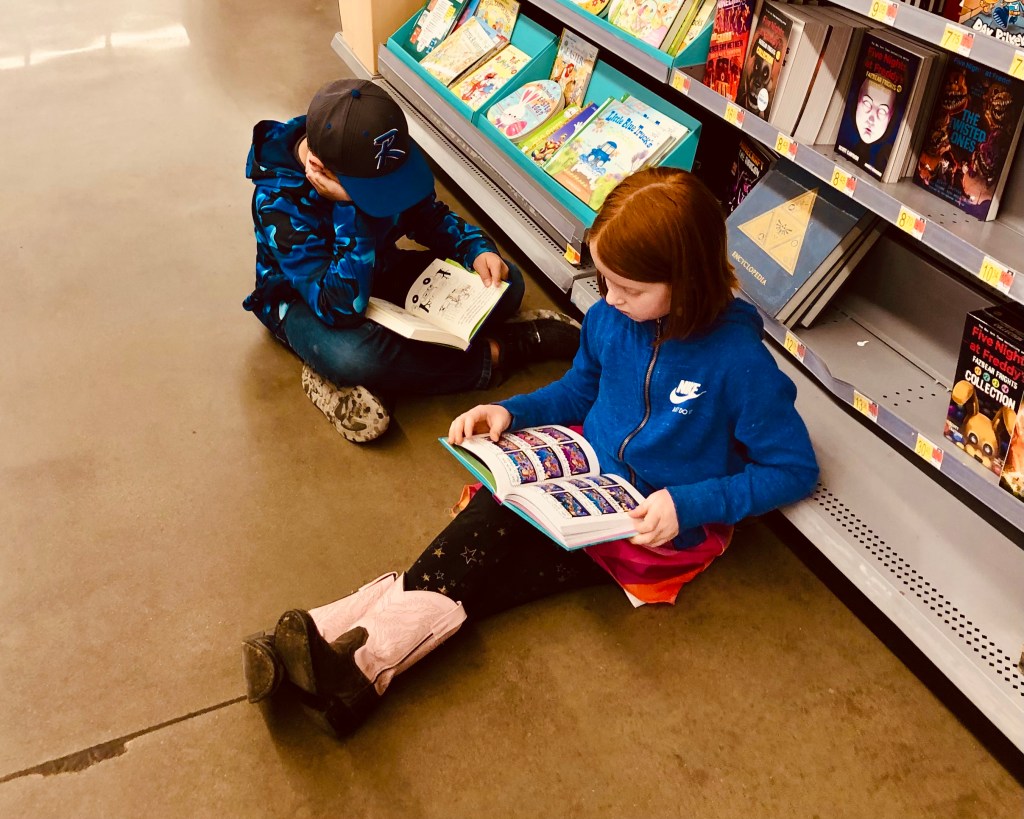
In a recent, relevant example from my own life, I take you to Walmart. I had several errands to run that night, one of which was making it to Sam’s before it closed at 8:00 pm. These stores are only a stones throw apart so when I checked the time at 7:20, I certainly had plenty of time. At this same moment, my children asked if they could read a book. Like, take a book off the shelf, sit their booties down in the aisle, and read the whole thing. So, because we had the time I said, “Sure!”

Anne Rulo It's Hard to Be Present in Our Fast World

At first, I was pleased. Who doesn’t want kids to read, right?! And, because the aisles were not crowded, they weren’t hurting a soul by plopping down and reading whatever caught their eye. Truth be told, I was rather proud of my chill. Unfortunately, that unraveled pretty quickly.

For the first few minutes, I was good. I checked my e-mail, social media, sent out a text or two. But then, I noticed I was growing uncomfortable. Nothing had changed. My children were still reading quietly and I still had plenty of time to get to Sam’s—but I started feeling anxious. Not anxious like nervous but anxious like I couldn’t sit still. I just couldn’t seem to get comfortable “being in the moment” because I wasn’t moving forward with tasks, purpose, and checking off of the proverbial list.

Thankfully, despite being uncomfortable I managed not to hurry my kids and we still made it to Sam’s in plenty of time. However, the whole situation caused me to reflect on how conditioned I am by the world’s pace and how I could stand a bit of reprogramming.

This pursuit of presence is not a new theme in my writing, but its repetition suggests how hard it is to accomplish sometimes. And, I know I’m not the only one who struggles with feeling so hustled by all the things that it’s hard to turn it off when we actually have the time and space to do so.

In the days ahead, my hope is that we can each take some time literally practicing being still. Being unstimulated. To test the boundaries of our to-do slot machines that don’t need to “ding” quite so often. While we are certainly designed to do work, we were never designed to operate at the levels the world will tempt us into if we chase every convenience, notification, and final drop of midnight oil.

Be still. At least sometimes.

When You Can’t See What God is Doing

Writing over at The Glorious Table today about a sweet little lesson I learned from the 2017 eclipse that swept the United States. See below for a preview or link here for the full post.

I am typically an “in-the-moment” kind of gal. I’m all about spontaneous adventures, being present, and looking for magic in the little things. But when a solar eclipse was on a path to be witnessed by a huge swath of the United States in 2017, I found myself completely underwhelmed. Definitely not like me.

For reasons unbeknownst to me, I just thought the whole thing seemed overblown. For weeks, there were T-shirts in Walmart and commemorative cups at work. I received endless communication from my kids’ school, telling us how they were going to let them safely witness the event without destroying their retinas. Of course, the headlines about it were everywhere.

Don’t get me wrong. I generally thought it was neat and understood that it might be a once-in-a-lifetime event. But, was it really going to be so cool that it deserved all this hype? Fast forward to August 21, solar eclipse day.

At the time, I was working on a college campus, and everyone received a little packet of solar-eclipse-related swag. It included the aforementioned commemorative cup, as well as sunglasses and a little screen-printed towel. We all left our offices and headed out together, pulling up chairs and blankets around the campus football field. The time the sun was in partial eclipse was long, nearly an hour and a half, but we were told “totality” would last only about a minute. I chatted with my coworkers and prepared to think, “Well, that was neat” and move on, underwhelmed. I could not have been more wrong, but not for the reasons you might think.

Anne Rulo When You Can't See What God is Doing

As I lay there on the grass, the darkness of “totality” was quick. It was shocking how dark it got, and I could hear the gasps of surprise from the hundreds of people around me. The most incredible thing was not the eclipse itself, or even the darkness, but the response from the natural world around us. As the sky went dark, the birds and bugs went absolutely bananas, making all the noises of nightfall. It was not just normal nighttime loud—it came on like a roar, all the natural things responding to this unique event.

Isn’t that interesting? The focus was a visual event, but because we couldn’t see it safely, instead, we had to pay attention to the awesomeness of everything around it, echoing how they were affected by the event.

In the time since the eclipse, I’ve felt foolish about my pooh-pooh attitude toward the whole thing. But as he does any time we don’t meet a moment with the right attitude, God has used that experience to teach me. One, to check my gratitude, and two, to show me how he doesn’t just show up in ways we can (or should) directly see. Sometimes, we only get to witness his awesomeness by paying attention to other signs.

Here are just a few of my own real-life examples:

  • I can’t look directly at this pandemic and see the good in it. However, I can see how it has prompted several family members and friends to quit jobs, change careers, and take risks that have benefited their lives in immeasurable ways. I can see how people have been forced to pause and reevaluate their lives.

For more examples, link to the full post here…

Women’s History Month: Celebrating Women in Mental Health

Closing out Women’s History Month with some neat “mini-bios” I got to write about female pioneers in mental health! Please see the preview below or link to Missouri Partners in Prevention for the full post.

As is common in history classrooms, sometimes we don’t always learn a complete representation of all the pioneers who contributed to a particular subject or science. This trend holds true in mental health where names like Freud, Pavlov, Bandura, and Maslow lead the way in many of our psychology and education classes. While these men were brilliant thinkers in their own right, our understanding of mental health care is only enhanced by learning about some of the brilliant women who also contributed in a time and culture that may not have been as welcoming to their leadership, ideas, or work.

Below are brief descriptions of just a few women who made incredible contributions to the field of mental health as well as links and resources to follow if you would like to learn more about them and many others not mentioned here.

Women Pioneers in Mental Health

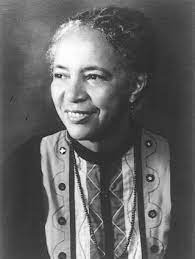
Dr. Margaret Morgan Lawrence, photo credit NY Presbyterian Health Matters

Dr. Margaret Morgan Lawrence: After losing her brother to a congenital condition, Dr. Lawrence was the only African-American student in her class and among only ten women at Columbia University’s College of Physicians and Surgeons. After beginning her career as a pediatrician, she later returned to school and became a psychiatrist. For 21 years, she served as the Chief of Psychiatry for Infants and Children at Harlem Hospital, accomplishing countless firsts not only for women but for African Americans in psychiatry.

Dorothea Dix, photo credit Wikipedia

Dorothea Dix: This exceptional activist transformed the profession of nursing through her work during the Civil War and later toured hospitals across the country, reporting troubling findings about the treatment of mentally unwell people. She later established asylums in several states and advocated for improved care for the mentally ill throughout the remainder of her life.

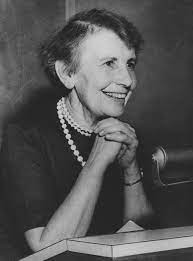
Anna Freud, photo credit Britannica

Anna Freud: Being the daughter of Sigmund Freud must have had an influence, not the least of which was introducing Ms. Freud in a very close way to the emerging field of psychoanalytics. Not only did she become an influential psychologist in her own right, she also was a pioneer in child psychoanalysis and an advocate for the expansion of children’s mental health care.

Nellie Bly, photo credit Wikipedia

Nellie Bly: Beginning her career as an investigative journalist, she learned of horrendous conditions endured by patients at a New York State asylum. She then posed as insane, lived within the walls of that facility for ten days, and then wrote an expose that led to mental health reform. Her experience is also detailed in a book, “Ten Days in a Madhouse.”

For the full post including additional mini-bios on Elisabeth Kubler-Ross and Elizabeth Packer, link here.

If Jesus Wasn’t In a Hurry, Maybe We Shouldn’t Be Either

As a child, I have distinct memories of a specific thing I used to do with my eyes when things were moving quickly. For example, any time I was laying on the floor below a ceiling fan I would try to visually catch one of the blades and follow it around at least once if not a few times, based on how quickly it was spinning. I was also the kid who would look out the car window on the highway, trying to keep my eyes fixed on some point in the distance as we flew past. Of course, with each of these, I was more successful seeing something when we were moving slowly and far less successful when we were moving quickly.

Anne Rulo If Jesus Wasn't In a Hurry, Maybe We Shouldn't Be Either

This childhood visual has stayed with me as a metaphor in our oddly “efficiency-obsessed” world. Yes, I am very grateful for microwaves, my family may not eat otherwise. Of course, I am super pumped that I can deposit my checks through a mobile app, especially since I don’t have a bank in my small town. And sure, I am fully on board with the no-more-commercials version of watching television. It’s awesome.

And yet, it is difficult to have efficiency in certain areas of life without being tricked into the belief that it is always a good idea. Because it’s definitely not. To that point, here is my best and most enduring example. The Big Guy Himself.

Jesus Was Not in a Hurry Physically

I cannot find a single example in the Bible where Jesus was in a hurry. In fact, if anything, He was decidedly unhurried and present in whatever He was doing, not allowing even death to change His pace or focus (ex. John 11:1-7 & Mark 5:21-43). I know that He didn’t have the same information or transportation technology we do but, He could do things like make the blind see (John 9) heal someone’s withered hand (Mark 3:1-6) and, transfigure into light (Matt. 17:1-13). Something tells me if Jesus had thought it helpful to bippity-boppity-boo Himself along from place to place He would have done so. But, He didn’t. There’s a message there.

Jesus Was Not in a Hurry Emotionally

As a mental health professional, this one is even more powerful. As much as I love that Jesus didn’t physically hustle His sandals all over the Middle East, He also didn’t hustle Himself or others along emotionally. In a culture that is notoriously pain-avoidant, we often don’t have good models for how to sit with pain. Instead, we often try to get past, over, around, under, or numb it to make it go away.

In contrast, Jesus seemed to understand that some emotion needs to be endured, rather than avoided or hurried. Nowhere is this more obvious than in the Garden of Gethsemane. In His final hours before being arrested, Jesus was clearly distressed. And yet, rather than avoid or hurry through, the account suggests that he spent at least three hours engaged with His emotions, in prayer, asking for help, eventually arriving at a space of acceptance for what lay ahead.

This example, while a powerful exclamation point, servs as a continuation of the pattern He had shown in previous moments when He didn’t make a woman stop crying, instead letting her wipe His feet with her hair (Luke 7:44-47) and crying with His friends when their brother died (John 11:32-35). He cried and let people cry. That’s pretty brave stuff.

Slowing Down Helps Us Love Ourselves & Others Better

While I know our culture and technology are different, Jesus’ example of patience and presence is a really powerful message. And, if implemented, it can also be a really valuable ministry for us. If we are not in a hurry we are better able to notice what is going on inside of ourselves, better able to bring it to our consciousness and prayer life. And, for others, we are more likely to notice suffering and be present enough to stop and help or at least support them while they hurt.

This world moves really, really fast but, that doesn’t mean we have to. We need to move slow enough to make sure that our eyes and hearts can catch what’s around us, rather than having it pass by in a blur. No one ever leaves this life saying, “I’m so glad I got everything done so efficiently.” But, we might just end up with the privilege of saying, “I’m so glad I slowed down and got to really live and love the world around me.”

Blessings on your braking.

Photo by Timon Studler on Unsplash, used with permission
Nothing is Too Messy for God

Last year, our family moved to a home in the country. Cows next door, can’t see my neighbors, beautiful views in every direction. It has been a place of deep rest for this introvert, regularly thanking God as in Psalm 18:19 for “bringing me out into a spacious place.”

I paint this picture of our rural Eden for the contrast ahead. As you might imagine, some of the roads around here are gravel, as is the case less than a half-mile from where I live. One of my very favorite things to do is take a walk down that road until I get to a high bridge overlooking a peaceful Moreau River. Most days this is where I pause, offer a brief prayer and intention for the day, then head back.

Of course, the very first time I ever walked to this bridge I didn’t know what I would find. I didn’t know I was going to pass a beautiful farm. I didn’t know there would always be two horses, one sway-backed and speckled, one sleek like Black Beauty. I didn’t know about the gurgling creek or the funny flock of turkeys. But, most of all, I didn’t know that in the middle of all this beauty I was going to have my brain and eyes seared by the graffiti that “decorates” this bridge overlooking the beautiful river.

Y’all, I am not kidding. I could sit in a room for hours trying to think really filthy thoughts and I wouldn’t come up with some of the stuff on this bridge. There are curse words everywhere. The racist and sexist language and images are at the least upsetting, if not disturbing. And the (ahem) anatomy. My heavens. It’s a full-on lesson in human sexuality. I’ve never seen anything quite like it.

So, why am I sharing about a graffiti-covered bridge over a beautiful Missouri river? Because God created such a sweet moment for me last fall, likely while I was standing smack on top of a rather colorful adaptation of drugs or genitalia.

Anne Rulo Nothing is Too Messy For God

That day, as I looked upriver with the early mist still rising, a deer stepped down from the bank. I’m really not trying to over-spiritualize it, but it was truly breathtaking. The song from Psalm 42 began in my mind, “As the deer panteth for the water so my soul longeth after thee” and I snapped a couple of pictures. She crossed slowly, stepping out on the other side, disappearing just as quickly as she arrived.

I stood there for quite a while, thinking about the beauty of that deer contrasted with the mess I was standing in on the bridge and teared up just a bit. It just felt like God was saying, “Nothing is too messy for Me, my child. I can always come to you, wherever you are.” Because, while this girl may not be spending time defacing bridges, I’m for certain making mistakes and messes somewhere. Of course, we all are.

Dear reader, today was just an opportunity to remind us no matter what mess we’re in, God can meet us there. We’ve never needed to be cleaned up for Him to show up. And, we’ve never needed to be anywhere near perfect for Him to cross right in front of us when we need Him most.

“As the deer panteth for the water
So my soul longeth after Thee
You alone are my heart’s desire
And I long to worship Thee”

Blessings on your beautiful, messy day.

Coping as We Wait for Spring

Writing over at The Glorious Table today about waiting for spring literally and in the “winter seasons” of our lives. Turns out, the ways that we cope in both of those “winters” can be similar. Read below for a preview or link to the full post here.

The changing seasons are one of the most tangible ways we regularly witness God’s design. Each year begins with the dark, cold months of winter, wherein nothing seems to be happening. Thankfully, those months eventually give way to spring, filled with bright green shoots of life and budding trees. The following warmth of summer feels abundant, with lush foliage, bright flowers, and temperatures that let us get out and enjoy our surroundings. Then, predictably, the temperatures drop, descending through the fall months into winter again. And so it continues, the seasons as they have always been and will always be, until the Lord comes again.

We experience this literal waiting for spring each natural winter. However, we also experience it figuratively in the “winters” our lives. Being a human in this broken world means each of us will occasionally have winter-like seasons. These times can last anywhere from days to years, sometimes making the wait for “spring” incredibly difficult to endure. Let’s consider some different ways “winter” can manifest in our lives.

Anne Rulo The Glorious Table Coping as We Wait for Spring
  • Winter is getting an odd test result and knowing you won’t know the full truth until next week.
  • Winter is a broken relationship and hoping it will someday be restored.
  • Winter is applying for a desperately needed job, school, or opportunity and not knowing when you will hear back.
  • Winter is a long health battle and being unsure which side of heaven the victory will be on.
  • Winter is a difficult career season and not knowing when or if you will enjoy your work again.
  • In short, winter is a hard season of waiting and hoping that spring will come as soon as possible.

Given that we all experience “winter” seasons when the world feels a little dark, cold, and lifeless, it is important that we explore ways to make it through. Rather than giving up in despair, these winter-like experiences are a time for “coping and hoping,” trying our best to believe God is doing his work out of sight just as he does with the natural world each year. In these difficult “winter” seasons, coping may look like:

  • Calling on friends and family like we do during the holidays and coming together for support
  • Hunkering down for a time as during a snowstorm and waiting for the worst to pass
  • Gathering our creature comforts, favorite foods, comfy clothes and finding enjoyment where we can
  • Treating it as we might during Advent, focusing on the hope that spring will surely come at some point
  • Making sure to celebrate when and what we can, even when the future is unknown
  • Remembering that all seasons are temporary
  • Reminding ourselves of the truth that God is always working, even when it’s dark and cold
  • Knowing that hope, in view of all that seems hopeless, is the stuff of deep faith

To assure you that these strategies are not just flippant suggestions from a carefree woman, I will share that my own life has only recently emerged from a lengthy “winter” experience. After years of transition and some career mismatches, our family finally seems to be entering a time of fruition and stability we have not known for a long time. I am so deeply grateful to be in this new spring season but, I remember all too clearly how hard that winter wait was, even as people reminded me spring would someday come.

To finish reading the full post, along with some encouraging verses, link here.