Giving Our Kids the Gift of a Neutral Response

We had been out of school for hours when a little voice piped up from the back seat.

6y/o: “Hey Mom, you know what a boy said to me today at recess?”
Me: (bristling because I can hear she’s upset) “What’s that, honey?”
6y/o: “He said,” (voice growing louder and shakier) “Boys go to college to get more knowledge, and girls go to Jupiter to get more STUPIDER!”

I tell you what, it was a good thing I was sitting in front of her because, at that exact moment, I found myself caught between several competing responses.

On the one hand, I wanted to laugh because 1) I was a little relieved and 2) that ridiculous saying has been around for-ev-er and it sounded impossibly cute coming out of her mouth. On the other hand, I could definitely feel my internal feminist uprising, ready to steal the entire moment.

Instead, I settled on this: “Huh. What did you do?”
6y/o: “I frowned at him and walked away.”
Me: “What do you think he thought?”
6y/o: (confidently) “I think he knew that wasn’t okay.”

Phew. She handled it. And, more importantly, she felt good about how she handled it. And, I would never have known that if I hadn’t offered her a neutral response. I’m so grateful for this option to offer as a gift to our kids in conversation.

Anne Rulo Giving Our Kids the Gift of a Neutral Response

How & Why to Offer a Neutral Response

Neutral responses sound like they should be easy, but they often aren’t. We live in a culture where opinions dominate and neutrality and listening are sometimes labeled as weakness. And, when it comes to our kids, of course we don’t feel neutral. We have opinions on most of what they share with us. But, we have to figure out when it is helpful to share it.

Neutral responses work like this. When our kids offer us information, our job is to simply offer a neutral word (huh, yeah, really) followed by a “prompt” to keep them talking (what did you do, what do you think, what do you feel, how did that work out, etc.) Here are some reasons why this “neutral response” approach can be helpful:

  • It allows us time to gather more information.
  • It shows our child we are interested in hearing how they handled the situation.
  • It gives us time to gather/evaluate our emotions. Our gut-reaction responses are often driven by our own emotions rather than what’s in the best interest of the other person.
  • It lets our kids tell us what happened without being shut down or swayed by our opinion. This one is HUGE. Our kids are affected by our reactions.
  • It conveys trust and confidence in their ability to think through and manage their own lives (which is a major goal of growing up).
  • It establishes a norm that helps our kids feel safe coming to us when the problems get much, much bigger than what happens on the playground.

“My teacher is mean to us.”
“Really? Tell me more about that.”

“My friends leave me out at recess. I don’t have anyone to play with.”
“Yeah? What do you doing during that time?”

“Lots of kids say cuss words at school.”
“Huh. What do you do when they do that?”

(Because we need this for those future moments when we really need them to come to us…)
“Hey Mom, some kid offered me drugs at a party.”
“Yeah, buddy? How did you handle that?”

Offering a neutral response doesn’t mean you don’t have an opinion. And, it doesn’t mean that you aren’t going to offer one at some point in an effort to help, guide, protect, or teach them. But, leading with a neutral response is often a great first step to let everyone get their bearings so you can move forward with information, compassion, a clear head, and a child who gets the regular opportunity to grow in their confidence and practice independence.

Here’s to holding our tongue long enough to let them lead.

Photo by Benjamin Manley on Unsplash

Originally published 10/9/21, updated for freshness and clarity.

Anne Rulo’s Bible Studies: 3 to Choose From!

With the kiddos headed back to school, I know quite a few folks getting their ducks in a row for fall Bible studies. If you are in the process of choosing a study for yourself or a group, below are descriptions of each one to help you decide. As always, these are available on Amazon and you can read about them on my website as well. I am always thrilled when somebody enjoys one of the convenient yet challenging (and occasionally humorous) dives into the Word. Thanks for the support!

Anne Rulo Bible Studies Cultivating Joy The God Blanket When Faith Does

Cultivating Joy (Philippians)

Cultivating Joy was the very first study I put out in 2018. It covers the book of Philippians and the practices and principles Paul uses to cultivate joy, rather than frustration or disappointment. It has a lot of practical applications that are influenced by my training as a mental health therapist and more than a few amusing thoughts and stories. As with all of the studies, it is designed with all of the verses, reading, and questions included for five weeks of study, four days of study per week. To order link here.

The God Blanket (Colossians)

The God Blanket came out in the fall of 2020 and was a unique labor of love during the pandemic. Of the three, it is the most “theologically dense” and challenged me in research and history in ways the others did not. It has some neat ties to the Old Testament and, despite the intensity of some of the text, consistently returns to a theme of us forever and always being “covered” by Christ’s sacrifice. As with all of the studies, it is designed with all of the verses, reading, and questions included for five weeks of study, four days of study per week. To order link here.

When Faith Does (James)

I have a unique affection for each book, kind of the way you feel about children’s individual personalities. James came out in the fall of 2022 and was a totally different experience. Not only was it my first book not authored by Paul, but James’s teaching is so direct. If you are looking for a grace-covered kick in the pants, this is your study. It’s hard but good, just as life and God are sometimes. I love the way he asks us to change and how convinced I am to do so as he makes his case. As with all of the studies, it is designed with all of the verses, reading, and questions included for five weeks of study, four days of study per week. To order link here.

If Your Summer Has Been a Bummer

Summer, particularly for those whose lives are impacted by the school calendar, holds the hopeful promise of rest. Even with an obligation here or there, we often hope summer is different somehow in terms of fun, space to breathe, the chance to travel, rest, catch up, or whatever else may feel beyond our reach during the school year.

That said, it occurred to me the other day that I have a very clear memory of one of my favorite summers ever. During the seven years I worked in higher education, 2014 was especially sweet. It wasn’t for any particular reason, just a series of pleasantries like the weather being wonderful, good times with family and friends, some travel, etc.

So, it stands to reason if I can identify an amazing summer, others have not been that way. Of course, some are just neutral. But, others are a bummer. This may be bummer with a lowercase b, as in mildly disappointing. Or, they can be Bummer with a capital B, because they are extra hard.

Because summer is something we often hoist on a pedestal, it can be harder to cope when things don’t go well or as expected. If that is the case for you this year, here are some strategies for managing the unique disappointment that can come when your summer is a bummer.

Coping When Your Summer Has Been a Bummer

Pair Grief with Gratitude: Navigating real life means that we cannot pursue only grief or only gratitude. It is a rare moment indeed where fully embracing one or the other is the best way forward. Instead, life is most often a combination of stuff that is hard and things we can be grateful for. If your summer has been a bummer so far, consider this your permission to grieve. Even for things that feel like a “privilege” (i.e. a trip being canceled, vacation not going as planned, etc.) it’s okay to be bummed out.

Then, as you allow yourself to think about what you wanted but didn’t get, reach for the gratitude of what you have. Rather than toxic positivity where we only “think about good things” and neglect the rest of our human experience, we want to honor both to find the way forward.

To finish reading the additional tips, “Retrieve What You Can” and “Embrace Impermanence” see the original link at Partners in Prevention, here. Appreciate this platform they share!

It’s Okay If You Need More Stones

Anne Rulo It's Okay If You Need More Stones

For anyone battling giants (or hoping to encourage someone who is), today we’re going to revisit one of the most familiar stories in the Bible—the battle of David and Goliath. For, as well-known as this story is, I found myself both thrilled and comforted when I only recently noticed one previously-overlooked detail. Here it is:

“Then he [David] took his staff in his hand, chose five smooth stones from the stream, put them in the pouch of his shepherd’s bag and, with his sling in his hand, approached the Philistine.” 1 Samuel 17:40 (NIV)

David took five stones into battle. And all this time I had only paid attention to the one he actually ended up using.

Of course, God is not one to mess around with minutia. He provides specific details when they are necessary for understanding, instruction, and follow-through. So, why would God have us know that David prepared with more stones than necessary? Why would God tell us that David seemingly headed into battle with a plan to fight longer than he ended up needing to? Does David’s “over-preparing” possibly suggest that he did not truly believe in God’s power and victory?

On the contrary.

I suggest that David bringing more than one stone to the battle says something important about his heart. And, it says something deep about his faith. And, for us, it speaks volumes about how God’s people might want to go about preparing themselves to face their giants.

David’s preparation did not reflect a lack of faith in God. In fact, it reflected the fullness of it.
David was prepared to fight the giant as long as God wanted.

While we know today that David would need only one stone, at the time David knew no such thing. Even with all his confidence in God, David had no way of knowing how many attempts it would take or how many times he may miss the mark along the way. David’s preparation to try and try again points to his trust in God’s timing and the understanding that a loving God does not always grant victory right away.

Sometimes we make the mistake of thinking if we are REALLY strong in our faith then our giants will fall more quickly. If I REALLY believed in God’s power then the battles in my life would be won in less time. In truth, our trust in God is most evident when we show up to face our giants, again and again, no matter how many stones it takes. As we grow in our faith we come to know that some giants just take longer to kill…and that God can love us and let us battle at the same time.

So be David. Humble swagger yourself right up to the battle line and fling that stone, and another, and another at that giant until it falls. And, when it does, listen for the rattle of those leftover stones in your pocket. That is the sound of God’s victory over your heart.

Originally published on April 24, 2019, updated for clarity and freshness.

What Are the “Boring Blessings” of Your Spouse?

Anne Rulo What are the boring blessings of your spouse?

One of the coolest things my husband and I get to do together is speak at marriage events. We love to be real with folks, make them laugh, and share a bunch of little relationship nuggets hoping they will bless someone. Today, I’m stopping here to share just one.

One of the greatest lies the world feeds us is that we should be chasing a revolving wheel of excitement. Unsurprisingly, that lie extends to marriage. The picture we see in the media suggests that marriage should be filled with fireworks. We see people passionately in love, longing for one another at their desks until they can be back together. The media also paints a picture of firework-filled difficulties. Marital arguments are often portrayed as intense, harsh words followed by deep regret and heroic efforts to “make up.” Anything in between these extremes is often vilified. Couples are shown passing each other in the kitchen, pitiful expressions under fluorescent lights with a background of mournful music. Yep, if those pictures were the truth about day-to-day life, I would want the fireworks too. But that is not how life is designed.

Real marriage is filled with years of grocery runs and laundry. It’s the thing that happens when you are picking up your kids from school and figuring out who is going to start dinner. Marriage is knowing who usually makes the bed and who takes out the trash and knowing instinctively in which direction you step around each other in the hallway. It’s what happens between two people as they live out common routines serving a common commitment. It’s a whole bunch of pretty predictable days lived out next to the person you love.

“Enjoy life with your wife, whom you love, all the days of this meaningless life that God has given you under the sun–all your meaningless days. For this is your lot in life and in your toilsome labor under the sun.” Ecclesiastes 9:9

I LOVE this verse about marriage. I know it sounds really pitiful at first but there is actually a gem of a gift hidden inside. God confirms that everyday life is fairly meaningless in the grand scheme of things. He acknowledges that we spend a lot of time laboring over the day-to-day process of life. And He says that smack dab in the middle of all the monotony is the ability to enjoy life with our spouse whom we love. What an incredibly freeing statement.

When we speak at retreats we encourage couples to consider the “boring blessings” of their spouse. Rather than focusing on what you want to be more thrilling, zero in on the consistent ways your spouse contributes to your life. Develop gratitude for the everyday regular ways you toil in this life together. Be grateful that he always grabs the mail on the way home. Or that she dresses the kids. Or that he goes to work each day. Or she keeps the schedule. Or…whatever! There are so many predictable, “boring” ways that we do life together and if we forget to be grateful for them we miss daily opportunities to appreciate our marriage and our spouse and grow in our love for one another.

So please, save money and go on a fancy vacation. Plan a special Valentine’s Day. Surprise each other once in a while. But remember, those moments are too few and far between to create sustainable happiness. You do not have to chase highs in your marriage. In fact, we really aren’t designed to. God has promised us the ability to enjoy life with the one we love right there in the middle of the everyday. For it is the everyday that is the gift.

My husband just walked in with the mail. I think a kiss is in order.

Happy marriaging everybody!

5 Summer Wellness Tips

Summer is a time when many people feel a little bit better simply because we get some extra sunlight, maybe a vacation, and some great outdoor options. But summer can also present some challenges for our well-being. For those who may be feeling a little “blah” this summer, here are five summer-specific wellness tips that may help usher the sunshine back into your life!

Anne Rulo 5 Summer Wellness Tips

Summer-Specific Wellness Tips

Focus on Function Over Form: Many of our warm summer activities result in showing more of ourselves than we may be used to or comfortable with. Additionally, media and diet culture have long inundated us with the idea of an ideal “summer body” or specific ways someone is supposed to look at summer events or in summer clothing.

However, we can reclaim some of this by focusing on the function over the form of our bodies. Simple examples may include enjoying the ability to go on a walk rather than criticizing the size of our legs or enjoying the feel of our body in the water rather than focusing on the appearance of a swimsuit. When we focus on what our body does rather than only valuing what it looks like, the opportunity for gratitude grows exponentially.

Earthing: This unbelievably simple, and scientifically backed, wellness technique is much easier to practice in the warm summer months. In short, it is the practice of putting ourselves in contact with the earth through barefoot walking, sitting, lying in the grass, etc. Simply standing or walking barefoot on the ground has been associated with reducing inflammation, increased immune response, psychological improvement, and more. Even ten minutes a day has been shown to be helpful.

Summer Morning & Evening Routines: Extended daylight hours make it so we aren’t having to pack everything that is helpful into such a short time frame. While there are always 24 hours per day, it is nice to have earlier mornings to spend on a walk or sipping coffee or later evenings for sitting outside for extended conversation or hobbies. Consider how you could use your additional daylight hours in ways that are restorative this time of year.

Be a Kid Again: 

Bring the Outside In: 

To finish reading these final two tips link to the full post at Missouri Partners in Prevention!

5 Strategies for a More Peaceful, Flexible Schedule

For some time now, our family has been living with some new strategies and boundaries around time and scheduling. And, while every family is different, I thought I would pass along what is working for us just in case it might be helpful for you. The peace and purpose around what sometimes felt like a runaway train has been truly wonderful.

Anne Rulo 5 Strategies for a More Peaceful, Flexible Schedule

5 Tips for Adding Space & Flexibility in Your Schedule

  1. Establish Your Measuring Stick. We all have a phrase that can reorient us to what really matters. Often, these are things we think about at big events like graduation, funerals, etc. But, we’re missing out if those are the only times our thoughts and choices match our core values. For us, with children who are 8 and 11, our catchphrase has become, “What do we want to be true in 10 years?” It is so much easier to figure out whether I want to delay dinner a few minutes to cuddle or the value of a potential activity when I think about what I want to be true when they are 18 and 21.

  2. “Leave Room for the Holy Spirit.” I know this phrase may remind you of an old Sunday School teacher but, I kid you not, these are the exact words that came to mind when I was praying about our schedule. In short, it just means seeking to create enough space (mentally, emotionally, spiritually) that we can experience God’s direction rather than our own. As we’ve left more unplanned, less back-to-back time in our schedule it has been neat to experience how He either fills it with surprise joys or open-ended, unplanned peace.

  3. Remove Access to Time Suckers: This one is going to be super individual but, for me, there has been a big shift in technology. In a non-unique move, there is no longer social media or email on my phone. It has been very freeing to check those only on our desktop during work hours. But, the real game changer has been burying access to a search engine. Now every fleeting thought, “Does Cher have a last name? Do turtles really breathe out of their butts?” does not turn into a rabbit-hole search that I emerge from 30 minutes to an hour later.

  4. Put Space Between the Ask and the Yes: This might be my favorite. As a recovering perfectionist and people pleaser, saying yes impulsively to others’ needs is a well-worn pastime. With rare exception, I now put at least 24 hours between requests and yes (or no). The 24-hour rule is also in place for emails because emails tend to breed more emails whether you respond to them immediately or the next day. It initially made me so uncomfortable to do this but it has drastically eliminated having “yes regret” and unnecessarily repetitive communication.

  5. Create Accountability: Okay, last but not less important. While the guidelines above create some structure, having another living, breathing human for accountability has been helpful. When my husband or I have an opportunity or the kids have an activity, we chat. Instead of, “Can we fit this in?” or, “Sure, that day is open,” we now ask questions like, “Does this allow us to spend enough time together?” and “Is this a good opportunity but not a God one?” etc. In short, nobody says yes without checking with the other and, just because it fits doesn’t mean it’s a yes. It’s a nice way to inject perspective and only “intentional yeses” into what used to be such an impulsive process.

Okay folks, I know these are individual to our journey but I hope some are helpful to you. As of this post, we are six months into these changes and it has been a truly valuable shift for our family. No longer are we saying yes impulsively, nor are we living so fast that it feels like ten years from now will hold regret. It’s been freeing and comforting to feel like we are happening to our schedule instead of our schedule happening to us.

Here’s to leaving room for the Holy Spirit.

Photo by Tatiana Syrikova, used with permission

988 One Year Later: What We Know

Anne Rulo 988 One Year Later What We Know Partners in Prevention

Just over a year ago, I sat at our prevention conference, mouth agape at the sheer ambition of the 988 plan. The federal government, in partnership with the states, was planning to launch a nationwide system of crisis intervention for mental health, suicide, and substance use in the summer of 2022. The goals were strategic, smart, and almost unfathomable given how the system of crisis mental health care had previously operated. (Preview below or link to full article here.)

These were just a few highlights:

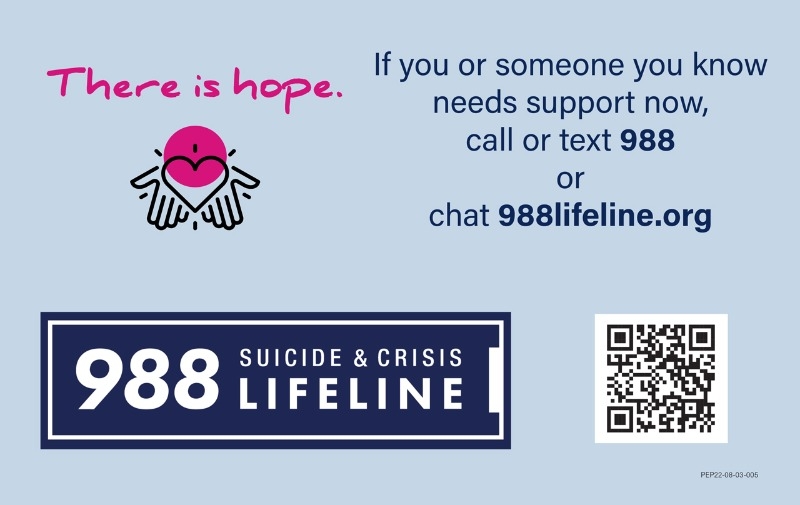
  • Change the previous ten-digit suicide lifeline number and make it easier to remember. Just as 911 is associated with emergencies for fire, medical, crimes, etc., the number for mental health crises would become 988.
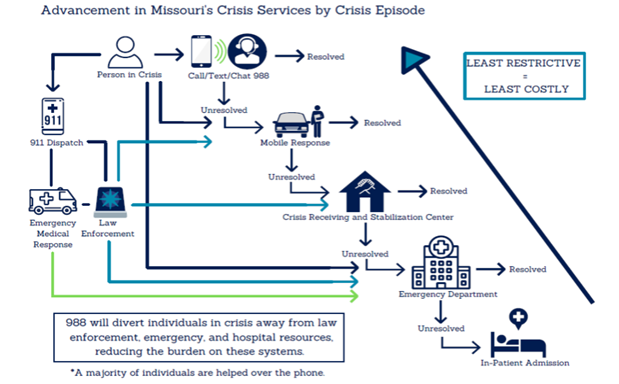
  • Create a “no wrong door” integrated crisis system focused on meeting mental health crisis needs at the lowest effective level. This included confidential call, text, and chat hotline options, mobile crisis response teams, and behavioral health crisis centers, with final stops at the hospital only as needed.
  • The availability of help from these additional points of entry would not only reduce healthcare spending but also help keep our law enforcement officers where they are needed instead of implementing jail time or spending long hours in hospitals waiting on evaluations.

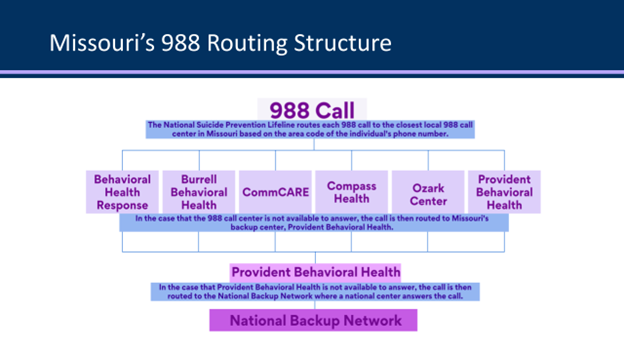
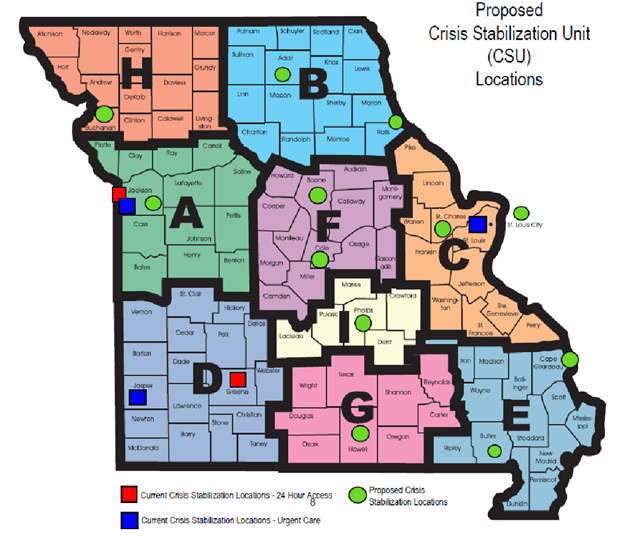
In Missouri, I remember hearing we were one of the few states who had prepared and were ready for the “soft launch” on July 16, 2022. I also remember seeing these charts that helped explain how this was designed to work in our state and local areas.

Anne Rulo 988 One Year Later What We Know Partners in Prevention

Anne Rulo 988 One Year Later What We Know Partners in Prevention

Anne Rulo 988 One Year Later What We Know Partners in Prevention

Anne Rulo 988 One Year Later What We Know Partners in Prevention

988 One Year Later: How’s it Going?

Back at this same conference, one year later, I was very interested to hear how this ambitious goal had been operating in real-time since the launch the summer before. Here are some of the highlights:

  • In just the first month of implementation, calls increased by 30%. It has continued to increase since that time but, the number of hospitalizations has not significantly increased. This is a nod to the effectiveness of lower-intensity interventions when someone is in crisis.
  • Trained specialists are available 24/7/365 and calls are answered in less than 30 seconds. There are options for different languages and special populations such as veterans and the deaf community. On the very rare occasion that lines are full, there is a nationwide backup center to answer all overflow calls.
  • For the full list of updated highlights click here for the full article at Partners in Prevention! Thanks to Missouri PIP for the privilege to publish with you!

Considering Going to Therapy? 5 Common Challenges

“If your car isn’t working you would take it to the mechanic.”

“Mental health care is just like physical healthcare. Take care of your body and your mind.”

“Going to a therapist isn’t weakness, it’s a sign of strength.”

Ever heard any of these? Me too. And, as a therapist, I believe them wholeheartedly. But, just because mental health care is as important as physical health care does not mean it is as easy to access. For a variety of reasons, acquiring mental health care can be challenging. Today we will address several of these difficulties and provide ideas and resources to help get the care you need! (To read about each of these obstacles in full, link to the post I wrote with Partners in Prevention below.)

  1. Internal Resistance
  2. External Resistance
  3. Cost
  4. Finding a “Good Therapist”
  5. Wait Time